How to Get an NOC for Land Sale in Assam – Step-by-Step Guide 2026
Before you can legally register a land sale deed in Assam, you must first obtain a No Objection Certificate (NOC) from the Deputy Commissioner or Circle Officer. Without this, the Sub-Registrar will not register your sale. Here is everything you need to know.
📋 Topics Covered in This Guide
What is an NOC and Why is it Required for Land Sale?
In Assam, the sale of private land — particularly land classified under the Assam Land and Revenue Regulation (ALRR) — requires a prior No Objection Certificate (NOC) from the government before the sale deed can be registered. This is because Assam has historically maintained strict governmental oversight on land transfers to prevent unauthorized sale of tribal land, forest land, and government-category land (Khamar, Sarkari).
The NOC serves as an official government declaration that the land in question has no legal encumbrances, is not subject to any acquisition proceedings, and the proposed sale does not violate any revenue or land-use restrictions. The Sub-Registrar's office is required by law to check for a valid NOC before proceeding with registration.
Without an NOC, even if a buyer pays and takes possession of land, the sale deed will not receive legal registration. An unregistered sale deed has no legal standing under Indian law and cannot be used in courts as proof of ownership.
Who Issues the NOC in Assam?
The authority that issues the NOC depends on the classification and size of the land:
- Circle Officer (CO): For standard residential or agricultural plots of regular size and category (most common NOC in rural areas).
- Deputy Commissioner (DC): For larger or commercially classified land parcels, land on the outskirts of gazetted towns, or any land above a specified acreage threshold.
- Revenue Divisional Commissioner (RDC): For cases involving disputed records, tribal land categories, or exceptional circumstances.
In practical terms, most citizens deal with the Circle Officer's office for regular residential and agricultural land. The CO submits a verification report to the DC who then issues the final NOC order.
Step-by-Step NOC Application Process
Prepare Your Application
The seller (current landowner) must write a formal application requesting NOC permission. The application should mention: Dag Number, Patta Number, Village, Circle, District, buyer's name, and the agreed sale consideration value.
Compile Documents and Submit
Attach all required documents (see checklist below) and submit at your Revenue Circle Office. Request an official receipt with application number for tracking purposes.
Revenue Circle Verification
The Circle Office assigns your case to the Lot Mandal who physically verifies the land plot, checks Jamabandi records, existing Khajana payment status, and ensures no government encumbrances exist.
Publication of Notice (in some cases)
For land sales above a certain value or in specific categories, the Circle office may publish a public notice for 15–30 days inviting objections from neighboring landowners or any claimants.
NOC Issuance
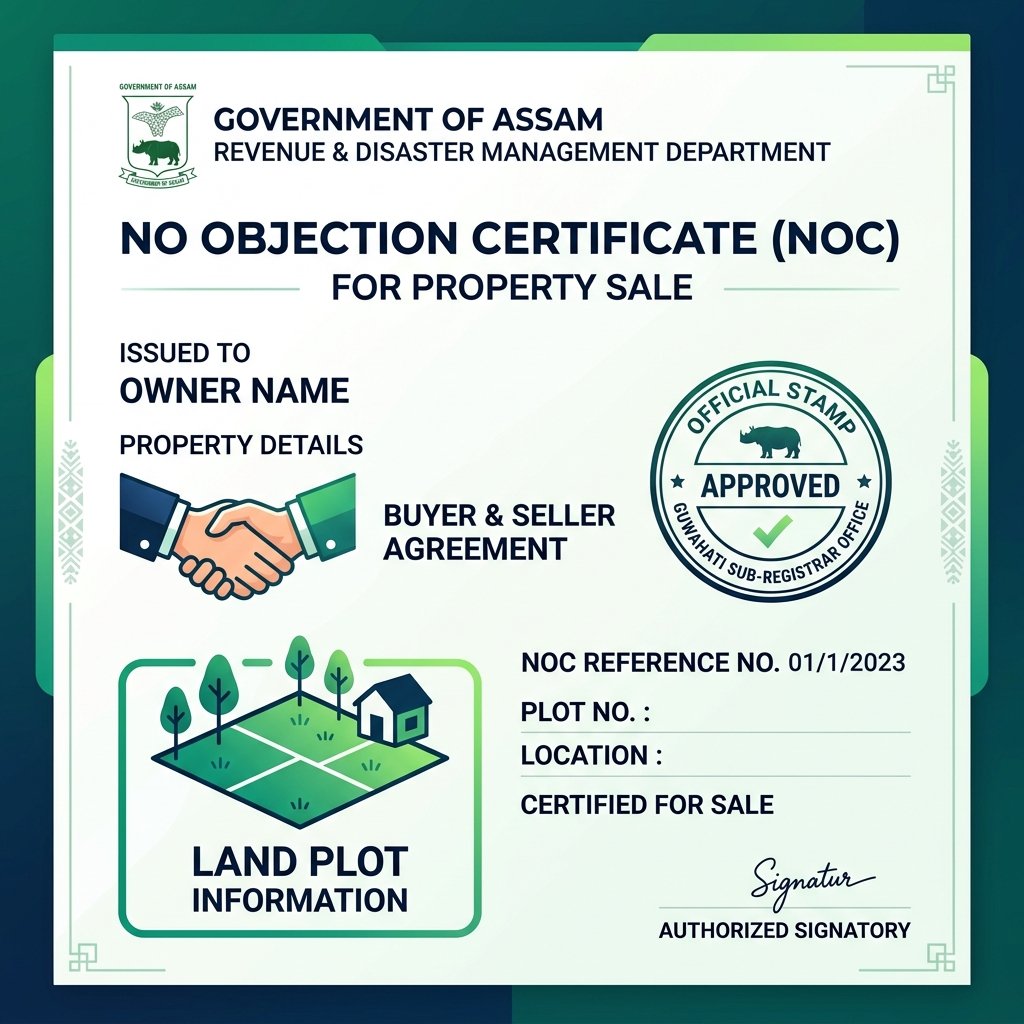
Once the verification is complete and no objections are received, the Circle Officer or DC issues the NOC. This document contains the Dag/Patta numbers, approved sale details, and an official government seal and signature. It is valid for a limited period (usually 3–6 months).
Proceed to Sub-Registrar for Sale Deed Registration
With the NOC in hand, both buyer and seller visit the Sub-Registrar's office in the relevant district to execute and register the sale deed. The Sub-Registrar will verify the NOC before stamping the deed.
Complete Document Checklist for NOC Application
How to Track Your NOC Application Status
After submitting your NOC application, you can track its progress through multiple channels:
- RTPS Assam Portal: Visit rtps.assam.gov.in and use the application tracking feature with your receipt number.
- In-person inquiry: Visit the Circle Office counter with your acknowledgement receipt, typically 2 weeks after submission.
- Circle Officer's email/helpline: Many districts now provide officer contact on the district administration website.
Common Reasons for NOC Rejection
- Pending govt acquisition: If the land falls under a notified acquisition corridor (road, railway, power line), NOC will be refused.
- Tribal land restrictions: Scheduled Tribe land cannot be sold to non-tribals in restricted zones without the DC's special approval.
- Unpaid Khajana: If annual land revenue is in arrears, NOC is put on hold until dues are cleared.
- Active mortgage or loan lien: If the land is currently mortgaged with a bank, the lender must provide a release letter before the NOC is issued.
- Disputed ownership: If there is an active court case or dispute on the Dag, the NOC will be withheld until legal resolution.
Validity Period of the NOC
An NOC issued by the Circle Officer in Assam is typically valid for 3 to 6 months from the date of issue (specific validity is printed on the document). If the sale deed is not registered within this period, the seller must apply for a fresh NOC.
This validity period means that both the buyer and seller should ensure their stamp duty is ready, lawyer is appointed, and Sub-Registrar appointment is booked before or shortly after the NOC is obtained — to avoid expiry.
Frequently Asked Questions
Can NRI sellers apply for NOC from outside India?
Yes. An NRI seller can grant a Power of Attorney (PoA) to a trusted relative or lawyer in Assam to file and collect the NOC on their behalf. The PoA must be attested by the Indian High Commission or Embassy in the country of residence and then adjudicated in Assam.
Is the NOC required for a property gift deed (Daan Patra)?
Yes. Any transfer of land ownership — including gift deeds, settlement deeds, and exchange deeds — that requires registration also requires an NOC from the relevant revenue authority in Assam. The requirement is triggered by the registration process, not just sale transactions.
What is the fee for obtaining an NOC in Assam?
The government fee for the NOC application itself is typically a nominal court fee stamp (Rs. 8.25 to Rs. 30 depending on the district). However, you will spend more on the supporting documents — primarily the notarized affidavit (Rs. 200–500) and stamp paper.
How long does the whole NOC process take?
Under RTPS norms (Right to Public Services), the NOC should be issued within 30 working days of a complete application. However, practical timelines vary: busy urban circles may take 45–60 days, while rural circles may be faster. Hiring a land document specialist (Deed Writer) familiar with the local Circle Office routine can speed things up.