Complete Checklist for Buying Land in Assam: 20 Critical Verification Steps (2026)
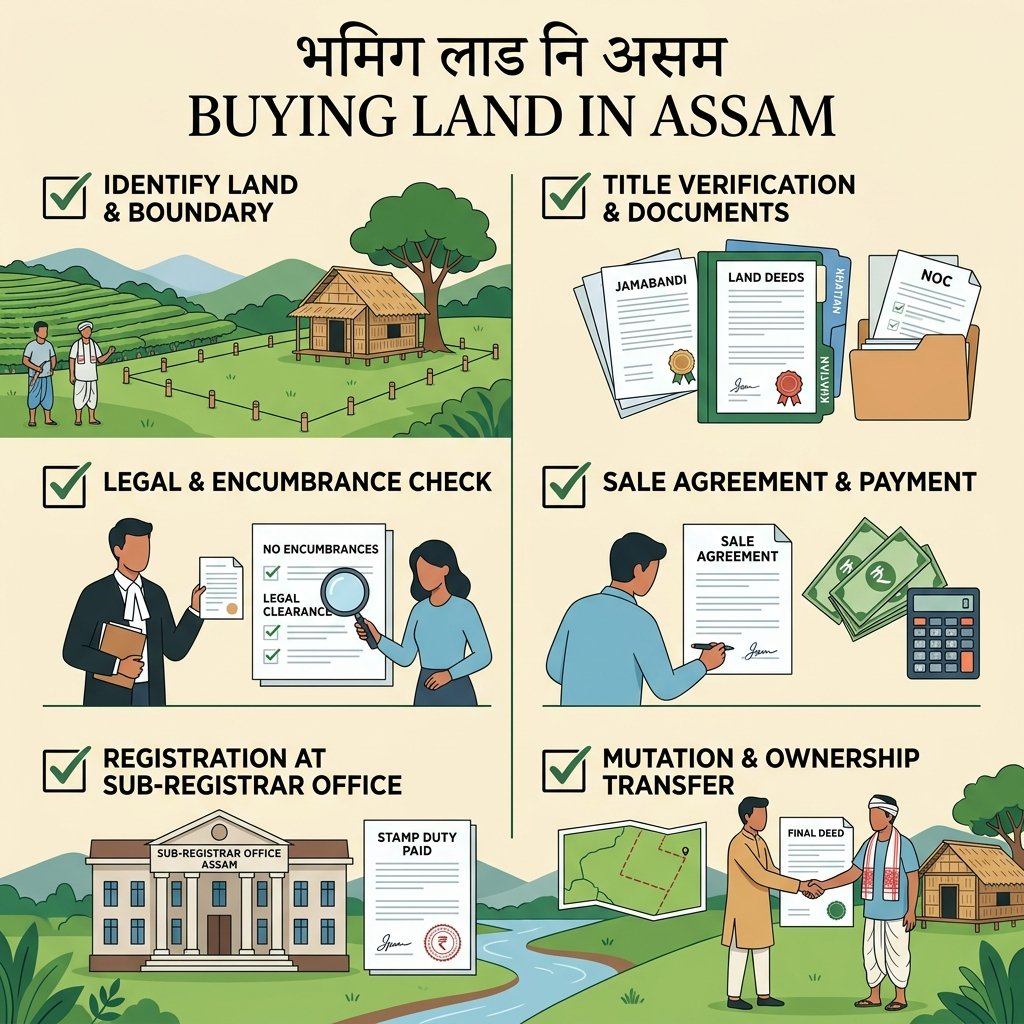
Buying land in Assam requires careful due diligence across multiple government records and legal documents. Skipping even one step can lead to fraud, disputes, or loss of your investment. This comprehensive checklist covers every critical verification you must complete before signing any agreement.
📋 Topics Covered in This Guide
- Before You Start: Title & Ownership Verification
- Checking for Encumbrances and Disputes
- Land Category & Classification Checks
- Measuring and Physically Verifying the Plot
- Legal Document Verification
- Financial & Tax Due Diligence
- The Registration Process
- After Registration: Post-Purchase Steps
- FAQs for Land Buyers in Assam
Phase 1: Title & Ownership Verification
Before engaging seriously with any property deal, your first step is to independently verify that the seller actually owns the land they claim to be selling. Never take the seller's verbal assurance at face value — verify every claim through the government portal.
✅ Verify Jamabandi on Dharitree ILRMS Portal
Go to ilrms.assam.gov.in and check the Jamabandi for the Dag Number provided by the seller. Confirm the Pattadar (owner) name exactly matches the seller's identity proof.
✅ Check for Multiple Owners (Co-Ownership)
Many land parcels in Assam are recorded with multiple co-owners (joint Patta). If there are 3 co-owners and only 1 is selling, you need NOC/signed consent from all co-owners. Buying from only one co-owner risks legal challenges from the others.
✅ Trace the Chain of Title for 30+ Years
Ask for all historical sale deeds going back at least 30 years. This establishes a "chain of title" proving the land was legitimately transacted each time. Any break in the chain (unexplained gap) is a red flag.
✅ Check for Pending Namjari (Mutation)
If the seller recently inherited or purchased the land, their name may not yet be on the Jamabandi. Always ensure Namjari is complete (seller's name appears on current Jamabandi) before finalizing the deal.
Phase 2: Checking for Encumbrances and Disputes
✅ Obtain an Encumbrance Certificate (EC)
Visit the Sub-Registrar's office for the relevant district and obtain a certified EC for the last 15–30 years. This document reveals all registered transactions — mortgages, loans, sale deeds — on the property. Any active mortgage must be cleared before sale.
✅ Check Civil Court Records
Visit the District Civil Court or check the e-courts platform to see if the land Dag number is mentioned in any ongoing litigation. Even if you buy legally, an active dispute can freeze the property for years.
✅ Verify No Government Acquisition Notifications
Check with the local Sub-Divisional Officer (SDO) whether the land or surrounding area is under any Section 4 acquisition notification under the Land Acquisition Act. Buying notified land means you inherit the acquisition dispute.
Phase 3: Land Category & Classification Checks
✅ Check Land Classification (Rupit, Faringati, Khamar)
The Jamabandi shows whether land is Rupit (cultivable), Faringati (barren), or Khamar (government reserve). Khamar land CANNOT be sold. "Jalah" (waterlogged) land has development restrictions. Verify the classification suits your intended use.
✅ Check Patta Type: Eksonia vs. Myadi
Assam has two primary land patta types. Myadi Patta is a permanent, hereditary title — the most secure. Eksonia Patta is a one-time lease-based title with renewal requirements and may have restrictions on transfer. Verify which type is applicable.
✅ Verify Tribal Land Restrictions
Scheduled Tribe (ST) community land in some areas of Assam cannot be sold to non-tribal buyers without DC's special permission. If the seller belongs to an ST community, verify this status and ensure necessary approvals are in place.
Phase 4: Physical Measurement & Map Verification
✅ Compare Physical Boundaries with Bhunaksha
View the Bhunaksha cadastral map on the Dharitree portal for the Dag number. Visit the site and physically walk the boundaries — checking fence lines, roads, and neighbor references against the digital map polygon.
✅ Get an Official Survey Measurement
For high-value transactions, hire a licensed government Amin (land surveyor) to physically demarcate and measure the plot using GPS instruments. This prevents area fraud and establishes legal boundaries for the sale deed.
✅ Check Access Road & Easements
Ensure the land has legal road access to a public road. Landlocked plots (no direct road access) are nearly impossible to develop or resell. Check for "right of way" (driveway access through another person's land) if applicable.
Phase 5: Legal Document Verification
✅ Verify Original Patta Document
The original Patta (land grant) document should be in the seller's possession. Check for the government seal, issuing officer's name, and registration number. Compare all details against the ILRMS Jamabandi extract.
✅ Verify Seller's Identity Documents
Cross-check the seller's Aadhaar, PAN, and Voter ID against the name on the Jamabandi. Any discrepancy (spelling variation, different address) should be legally reconciled before signing the sale deed.
Phase 6: Tax & Financial Due Diligence
✅ Check Khajana (Land Revenue) Payment History
Ask for all land revenue receipts for the last 5–10 years. Unpaid Khajana creates dues that become your responsibility after purchase. The Circle Office can also confirm dues.
✅ Verify Property Tax Clearance (Urban Areas)
For land within municipal limits (GMC area, town committees), also check property tax payment status with the municipality. Combined dues from Khajana and property tax can be large.
Phase 7: The Registration Process
✅ Obtain NOC Before Booking Stamp Paper
Apply for and receive the NOC from the Circle Officer or DC before purchasing stamp paper. The sale deed value and stamp duty should be based on the higher of the agreed price or the government circle rate (guidance value) for that area.
✅ Calculate and Pay Correct Stamp Duty
Use our Stamp Duty Calculator to estimate the fees payable. Register the deed on the computed value — never attempt to undervalue, as this is detectable through circle rate databases and can lead to legal penalties.
Phase 8: After Registration – Post-Purchase Steps
✅ File for Namjari Immediately After Registration
Do NOT delay Namjari. File your mutation application at the Circle Office within 30 days of sale deed registration. Bring the registered deed, your Aadhaar, and the Jamabandi copy. Without Namjari, your ownership is legally weak despite having a sale deed.
Frequently Asked Questions
Can I buy land in Assam as a person from another state?
Yes, with certain restrictions. Non-Assam residents can generally buy land in urban and semi-urban areas. However, agricultural land in many rural districts of Assam has restrictions on non-agriculturist buyers. Tribal Belts and Blocks have strong restrictions on non-tribal purchase. Always consult a local lawyer before proceeding.
What is the safest way to verify a seller's ownership claim?
The most authoritative verification is checking the Jamabandi on the Dharitree ILRMS portal directly. The portal shows real-time data from the government's own database. Supplement this with an independent search at the Sub-Registrar for encumbrances and a visit to the Circle Office to check for any NOC or acquisition proceedings.
Is a Power of Attorney sufficient to buy/sell land in Assam?
A Power of Attorney (PoA) allows an authorized agent to act on the principal's behalf. For land sale registration, a registered PoA is generally accepted. However, some restrictions apply — for example, a PoA holder cannot further sell the same land to themselves. Always verify all PoA duties and limitations with a qualified lawyer.