How to Correct Name Spelling Mistakes in Your Assam Jamabandi – Complete Step-by-Step Guide
Even a single alphabet difference between your Aadhaar card and your land record in Assam can completely block your ability to sell your property, obtain a bank loan, and even participate in government schemes. This guide explains exactly how to resolve this.
📋 What You'll Learn in This Guide
Why Exact Name Matching on Jamabandi Matters
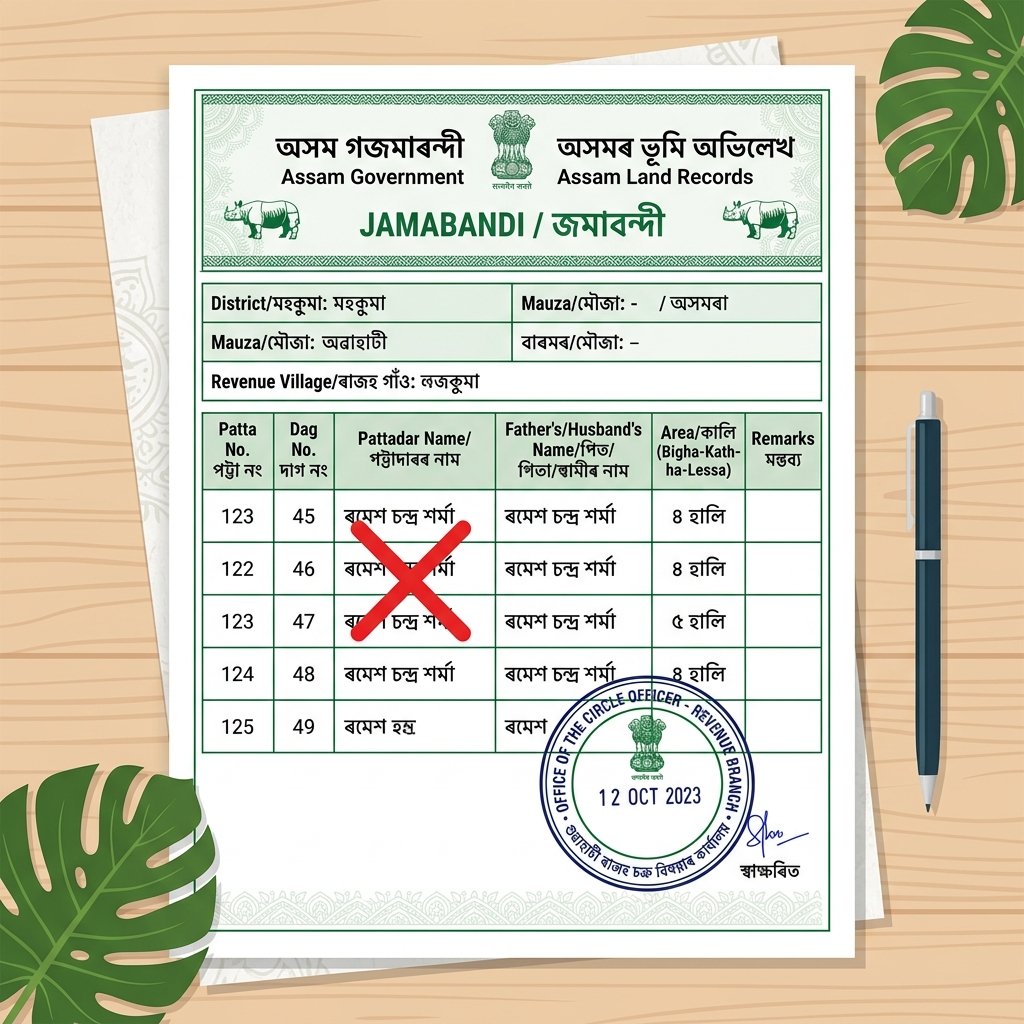
The Jamabandi (also called the Record of Rights or RoR) is the foundational legal document that establishes your ownership over a parcel of land in Assam under the ILRMS system. When the name printed on this document doesn't perfectly match the name on your government identity proof (Aadhaar, PAN, or Voter ID), it creates a legal grey zone that has serious downstream consequences.
Banks and financial institutions in Assam now cross-verify land records via the Dharitree ILRMS portal before sanctioning any land-mortgage loan. A discrepancy as small as "Rajiv" vs "Rajeev" will immediately trigger a rejection. Similarly, if you attempt to register a sale deed at the Sub-Registrar's office, the Circle Officer's verification of your Jamabandi will flag the mismatch — potentially halting your property deal.
Furthermore, during inheritance-based mutations (Namjari proceedings), the records of the deceased must match across all presented death certificates, Jamabandi copies, and family affidavits. A spelling error in the original owner's name causes the entire succession process to stall at the Lot Mandal verification stage.
Common Types of Errors Found in Jamabandi Records
Before beginning the correction process, it's important to identify exactly what kind of error is present in your record. The correction procedure can slightly differ based on the type:
- Phonetic Spelling Variations: e.g., "Hemanta" vs "Hemonto", "Pranab" vs "Pronob". These are the most common errors from Bengali/Assamese phonetic transliteration into English.
- Transposed Characters: e.g., "Kalita" vs "Klita" — characters accidentally swapped or dropped during data entry.
- Missing Middle Names or Initials: Some records only captured the first name or dropped the father's initial that appears on the ID card.
- Extra / Missing Spaces: e.g., "Rabindra Nath" vs "Rabindranath". While this seems trivial, some automated bank systems treat them as different names.
- Completely Wrong Name: In rare cases, the digitization incorrectly merged or swapped names between two adjacent records in the original chitha.
The Official Correction Process – Step by Step
Name corrections in Assam Jamabandi records are handled through your local Revenue Circle Office. This is a purely offline process as of 2026. Here is the exact procedure:
Download & Verify Your Current Jamabandi
First, obtain an up-to-date copy of your Jamabandi from the Dharitree ILRMS portal at ilrms.assam.gov.in. Note the exact Dag Number, Patta Number, and Village details. Verify the error in black and white on the printout.
Write a Formal Application to the Circle Officer
Draft a clear application letter addressed to the Circle Officer (CO) of your Revenue Circle. The application must: (a) state your name as it incorrectly appears and as it should appear, (b) mention the Dag Number and Patta Number, (c) explain the reason the correction is needed, and (d) swear that you are the rightful owner and the correction is factual.
Obtain a Notarized Affidavit
Visit a local notary (available in most district courts Rs. 200–500) and obtain a sworn affidavit on stamp paper declaring that the name on the government ID and the name as it should appear on the Jamabandi both belong to the same person (you). The affidavit must be signed by two witnesses and carry the notary's seal.
Submit Your Application at the Circle Office
Visit your local Revenue Circle Office and submit all documents. Ask for an application receipt or acknowledgement number — this is critical for follow-up. Office hours are generally 10:00 AM to 4:30 PM on working days. The application stamp fee is typically Rs. 10–30 at the window.
Lot Mandal Field Verification
The Circle Office assigns your case to a Lot Mandal — a field revenue official who maintains the original village Chitha records. The Mandal will physically verify your claim against the handwritten original. If the error is an obvious clerical mistake made during digitization, the Mandal will recommend approval to the CO.
Circle Officer Orders Correction in ILRMS
Once the CO is satisfied, they will issue an official order to the data entry operator. The correction is then made in the Dharitree ILRMS system. Your updated Jamabandi will reflect the corrected name, and you can download it from the portal.
Complete Document Checklist
Assemble all of these documents before visiting the Circle Office. Missing even one can cause delays of several weeks:
📂 Documents Required for Jamabandi Name Correction
Expected Timeline & Fees
Here's a realistic breakdown of how long the name correction process takes, based on typical Circle Office workloads:
| Stage | Typical Duration | Notes |
|---|---|---|
| Application Submission | 1 day | In-person at Circle Office |
| Lot Mandal Verification | 1–3 weeks | May require you to be present |
| CO Approval & Order | 1–2 weeks | Depends on CO's schedule |
| ILRMS Data Update | 3–7 days | Automatically reflects on portal |
Total Expected Time: 3 to 8 weeks. Offices in Guwahati and other busy districts may be slower. Rural circles tend to be faster.
Fees: The government processing fee is typically nominal (Rs. 10–50). The main cost is the notarized affidavit (Rs. 200–500 depending on lawyer/notary). There are no official charges for the ILRMS update itself.
Can You Correct Your Name Online via the Dharitree Portal?
As of 2026, the Dharitree ILRMS portal does not provide a direct self-service option for citizens to modify or correct their Jamabandi data. All modifications to official land records must go through the Circle Office workflow as described above.
However, you can use the portal productively in two ways during this process:
- Download your current Jamabandi copy to include as part of your application.
- After the correction is made by the Circle Office, verify the updated record by checking your Dag number on the ILRMS portal within 7–14 days.
When You Need Namjari (Mutation) Instead of a Correction
A name correction is only valid when you are the current owner and your own name is simply misspelled. You do NOT need a name correction (and should NOT apply for one) in the following situations — instead, you need Namjari (Dakhil Kharij / Mutation):
- Inherited land: The previous owner (your parent or grandparent) has passed away, and you want your name added/changed to the Jamabandi as the new owner.
- Purchased land: You bought land from another person, and the seller's name is still on the Jamabandi. A sale deed alone is NOT sufficient — you need mutation.
- Gift deed land: Land was transferred to you via a registered gift deed. Again, Namjari is required to update the Jamabandi record.
Namjari is a separate and more involved process that requires publishing a public notice in the village, waiting for any objections, and then receiving a formal mutation order. You can check your Namjari application status at the Dharitree portal's Mutation section.
Frequently Asked Questions
Can I apply for name correction on behalf of my elderly parent?
Yes. You will need a Power of Attorney (PoA) document registered at the Sub-Registrar office authorizing you to act on your parent's behalf. Include a copy of the PoA in your application packet along with your own ID proof.
Will my old Jamabandi copy remain valid during the correction process?
For informational purposes, yes. But for legal or financial transactions (bank loans, sale deeds), the old copy with the spelling error will likely be flagged. It is advisable to wait until the corrected record is officially available before proceeding with any transaction.
What if the Lot Mandal rejects my correction claim?
The Mandal's recommendation is not final. If rejected, you can file an appeal with the Revenue Divisional Commissioner (RDC) of your division. You should present additional evidence such as old deeds, property tax receipts, or witness statements from neighboring landowners who can vouch for your identity on the record.
Is there a penalty for having an error in my Jamabandi?
There is no direct penalty, but practically it creates significant obstacles. It can delay property sales for months, lead to rejection of loans, and create complications in inheritance. It's strongly advised to correct any errors as early as possible.
My Jamabandi has the right name but Bhunaksha map shows the wrong one. Is that a different correction?
Yes. The Jamabandi and Bhunaksha are two different databases within ILRMS. If only the Bhunaksha (cadastral map) record is wrong, you need to approach the Circle Officer specifically for a map record correction, and the procedure will involve the Amin (surveyor) for technical verification.