How to Check Namjari / Land Mutation Status in Assam Online (2026)
Namjari (mutation) is the essential legal process through which the name on your Jamabandi is updated to reflect a new owner after purchase, inheritance, or gift. This guide explains how to track your Namjari application status online and offline.
📋 Topics Covered in This Guide
What is Namjari (Land Mutation) in Assam?
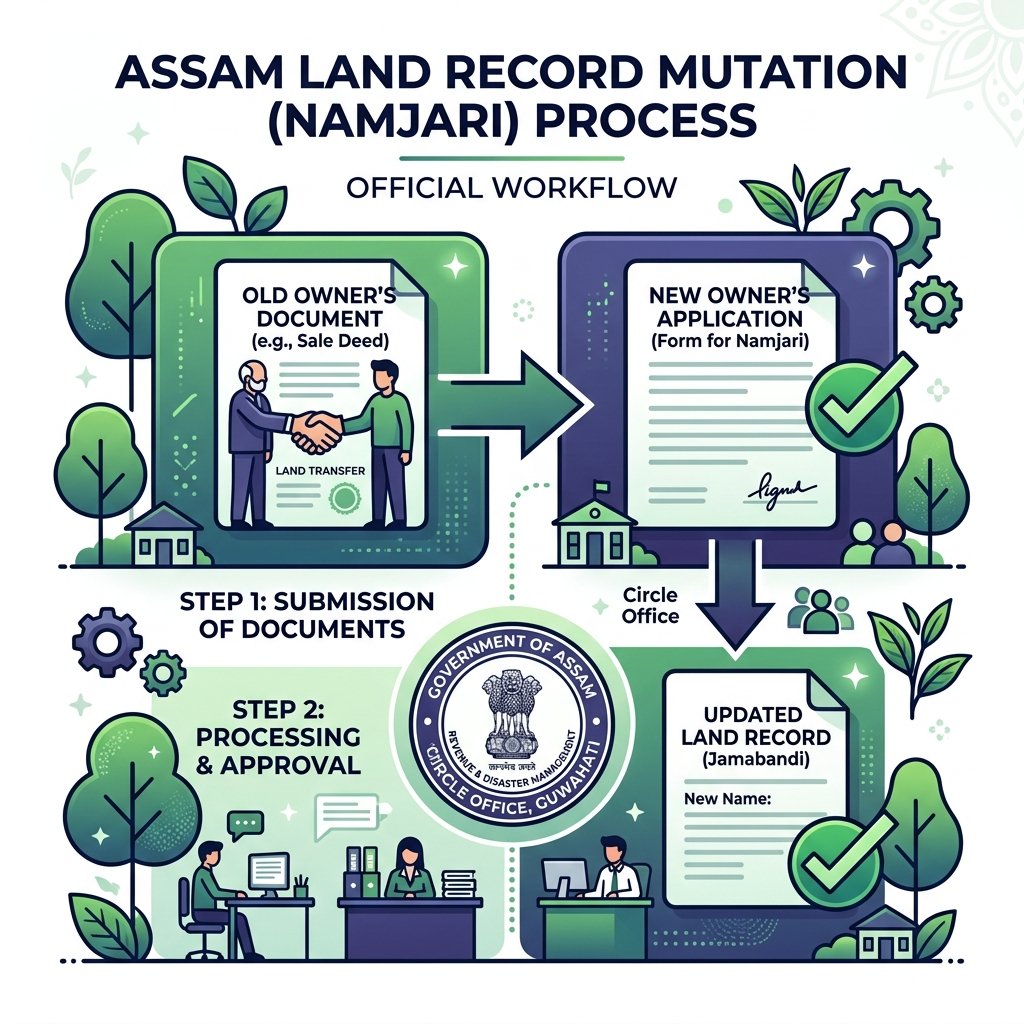
Namjari — also called Dakhil Kharij or land mutation — is the official administrative process by which the Revenue Department updates the Jamabandi (Record of Rights) to replace the old owner's name with the new owner's name. Until Namjari is complete, the name of the previous owner (deceased parent, previous seller) remains on the Jamabandi, even if you have a valid registered sale deed in your name.
In the Dharitree ILRMS ecosystem, mutation is the event that updates the core ownership data stored in the digital land records system. Every subsequent transaction — loan applications, further sale, NOC requests — will be based on the mutated (updated) Jamabandi.
Why Mutation is Critical After Land Purchase
Many buyers in Assam make the mistake of stopping after registration of the sale deed, assuming the process is complete. This can lead to serious problems down the line:
- Tax liability: The previous owner's name remains on Khajana (land tax) records until mutation, causing potential disputes on who is liable for annual tax.
- Loan eligibility: Banks will not approve land mortgage loans until the Jamabandi is mutated in your name — regardless of your sale deed.
- Further sale complications: If you want to sell the land in the future, the buyer's lawyer or bank will require a clean Jamabandi in your name. An unmutated record creates legal complications.
- Government scheme benefits: Many Assam state and central government scheme benefits (like PM Awas Yojana) are linked to the Jamabandi owner's name.
How to Apply for Namjari / Mutation in Assam
Submit Application at Circle Office
Visit the Revenue Circle Office of the taluk where the land is located. Submit a written application for Daskhil Kharij / Namjari. Attach all supporting documents and pay the nominal application fee.
Public Notice Publication
The Circle Officer publishes a public notice at the village level (panchayat board / village headman) announcing the proposed mutation. A waiting period of 30 days is given for anyone to file an objection.
Lot Mandal Field Verification
The assigned Lot Mandal visits the land, verifies the boundaries, interviews neighbors, and checks original village Chitha records to confirm the sale is legitimate and unchallenged.
Mutation Order Issued
If no objections are received and verification is successful, the Circle Officer issues the Namjari order. The ILRMS data entry operator updates the Jamabandi database to reflect the new owner's name.
Checking Namjari Status on the Dharitree ILRMS Portal
Once you've filed your Namjari application, you can monitor its progress online:
Visit the Official ILRMS Portal
Go to ilrms.assam.gov.in and navigate to the "Mutation" or "Namjari" section from the portal's main menu.
Enter Your Application Number
Use the Application Reference Number given on your receipt at the Circle Office. Enter your District, Circle, and Application Number to pull up your case status.
View Stage-wise Progress
The portal will show the current stage of your application — e.g., "Pending Lot Mandal", "Under Public Notice", "Approved", or "Rejected". If rejected, the reason for rejection will also be visible.
If you don't have your application number, you can also search by your Dag Number or Patta Number in the mutation search module.
Documents Required for Namjari
Expected Timeline for Namjari in Assam
Under the RTPS Act, the government is mandated to complete Namjari within 90 working days of application. In practice, the timeline varies:
- Uncomplicated cases (clear sale deed, no disputes): 45–75 days
- Inheritance cases (multiple heirs): 3–6 months
- Disputed cases: 6 months to several years (may require court intervention)
What Happens After Mutation is Complete?
Once the Namjari order is issued and ILRMS data is updated, several important changes take effect:
- Your name will appear as the Pattadar (owner) in the Jamabandi on the Dharitree portal.
- Annual Khajana (land tax) demand notices will be issued in your name.
- You are now fully eligible to apply for bank loans against this land.
- Download a fresh Jamabandi copy immediately after mutation completion as proof for future transactions.
Frequently Asked Questions
Can I pay Khajana (land tax) before the Namjari is complete?
Technically, Khajana is billed to whoever's name is on the Jamabandi (the old owner). However, as the actual occupant and deed holder, it is advisable to pay it in the old owner's name (with their consent or if deceased, through their estate) to avoid accumulation of dues. Keep all receipts as they serve as proof of continuous nexus with the land.
My Namjari got objected by a neighbor. What do I do?
When an objection is filed during the public notice period, the Circle Officer schedules a hearing where both parties (the applicant and the objector) can present their case. You will need to prove your legal ownership through the sale deed and supporting documents. If the CO rules in your favor, the mutation proceeds. If not, you can appeal to the Additional Deputy Commissioner (ADC) and then the Gauhati High Court if needed.
Is Namjari the same as an Encumbrance Certificate?
No. Namjari (mutation) is the process of updating the ownership record in the Jamabandi. An Encumbrance Certificate (EC) is a separate document issued by the Sub-Registrar's office showing whether the land has any registered charges, mortgages, or transactions against it. Both are important for different purposes in a land transaction.